I enjoy turning complex, data-heavy questions into useful tools and experiments. These personal projects span subtitles generation, machine learning, and statistical modeling.
ScribeForge
Status: In development
Focus: Privacy-first, browser-based video to subtitles generation
Repository: scribe-forge
ScribeForge is a privacy-first, browser-only video-to-subtitles service. The goal is to keep the entire media-processing workflow client-side, so the original video never needs to be uploaded to a server. It is currently in development.
I am using Mediabunny to inspect video files and extract audio tracks directly in the browser. The project is designed around practical constraints: supporting large files, multiple media and subtitle formats, and keeping memory usage under control.
Workflow:
- Extract audio from local video files without uploading the original video
- Analyze media metadata and identify available audio tracks
- Extract audio while avoiding unnecessary decoding and re-encoding where possible
- Designed to handle large video files while keeping memory usage under control
The subtitles would be created using an inference model like OpenAI Whisper. Users would need to provide credentials or an API key to access these services and submit the extracted audio for transcription.
The resulting subtitles created from inference would then be refined through UI or server-side processing. This would include fixing timing, fixing name, finding errors and other adjustments to improve subtitle quality.
Poker AI
Status: Revisiting an experiment started in 2020
Focus: Game theory, machine learning, and poker analytics
For this project, I adapted an existing research implementation based on this paper and used deep counterfactual regret minimization to train an agent for All-in or Fold poker. My work focused on adapting the system to the game variant, accelerating training, and building tools to analyze strategy and promotions.
- Trained multiple versions of the model overnight on Google Cloud.
- Adapted the implementation for All-in or Fold and modelled the expected value of site promotions.
- Built range charts to visualize regret and estimated value by starting hand and table position.
- Parsed real-world poker logs for deeper analysis.
- Used all-in equity as a shortcut during training.
- Modified the training workflow to take advantage of multiple CPU cores.
The original version modelled a jackpot promotion available on GGPoker at the time. Since the promotion has changed, I would like to update the assumptions and compare the resulting strategy with the original model.
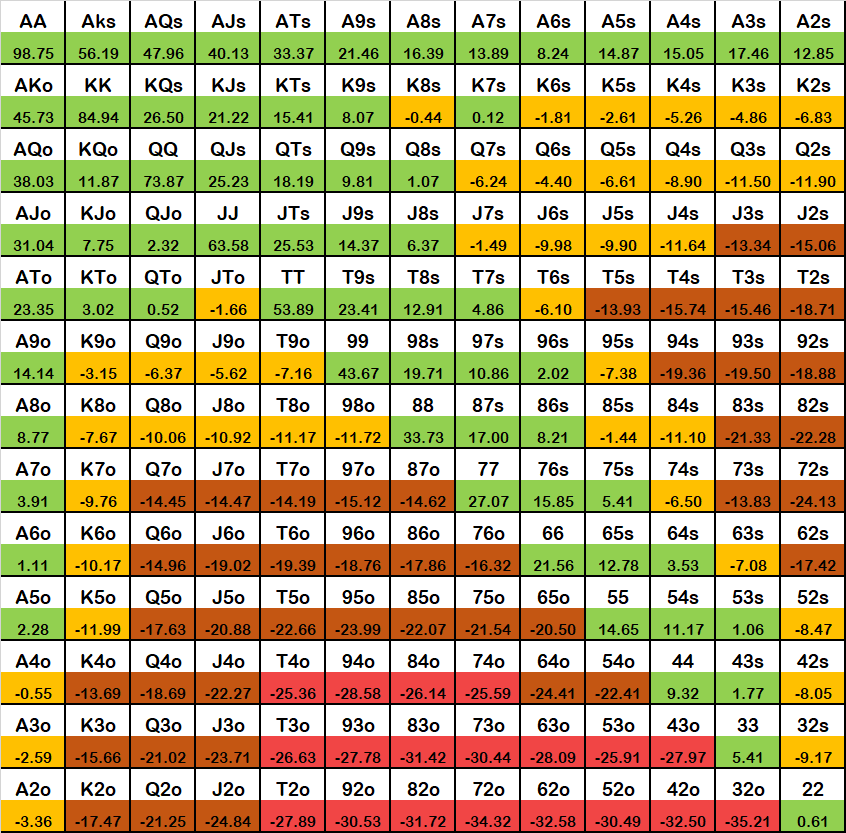 This is the chart for the under-the-gun (UTG) regret of a trained AI model. It is interesting to note that many suited connectors are +EV. This is because of the jackpot that could be won on the website if you made a straight flush with your hand
DFS Backtesting
Status: Completed experiment
Focus: Sports statistics and model validation through backtesting
I built a backtesting application to test ideas from this paper. The project combined two of my interests: statistics and sports odds. While also extending my machine-learning background into statistical modeling for NBA daily fantasy sports contests.
- Built a statistical model to estimate a player’s game result from that player’s closing prop line.
- Collected historical DFS contest data and player prop closing-line data to test the models.
- Displayed backtesting results to compare model performance.
Through the project, I worked with web scraping, Dirichlet distributions, linear regression, and Monte Carlo simulation.
I am most drawn to projects where a messy real-world question can become a useful model, system, or tool.